

Sourdough Sandwich Bread With Fresh Milled Flour Made Easy
Sourdough sandwich bread made with fresh milled flour can be easy. We just have to not overthink it! This loaf is perfectly soft, slightly sweet, and tangy at the same time. It holds up nicely to slicing, and spreads to make the perfect sandwich bread, and it is made with 100% fresh milled flour, unsifted, and leavened with a pure sourdough starter, and no yeast.
Updated Post on 8/14/2024 to include larger pan sizes.
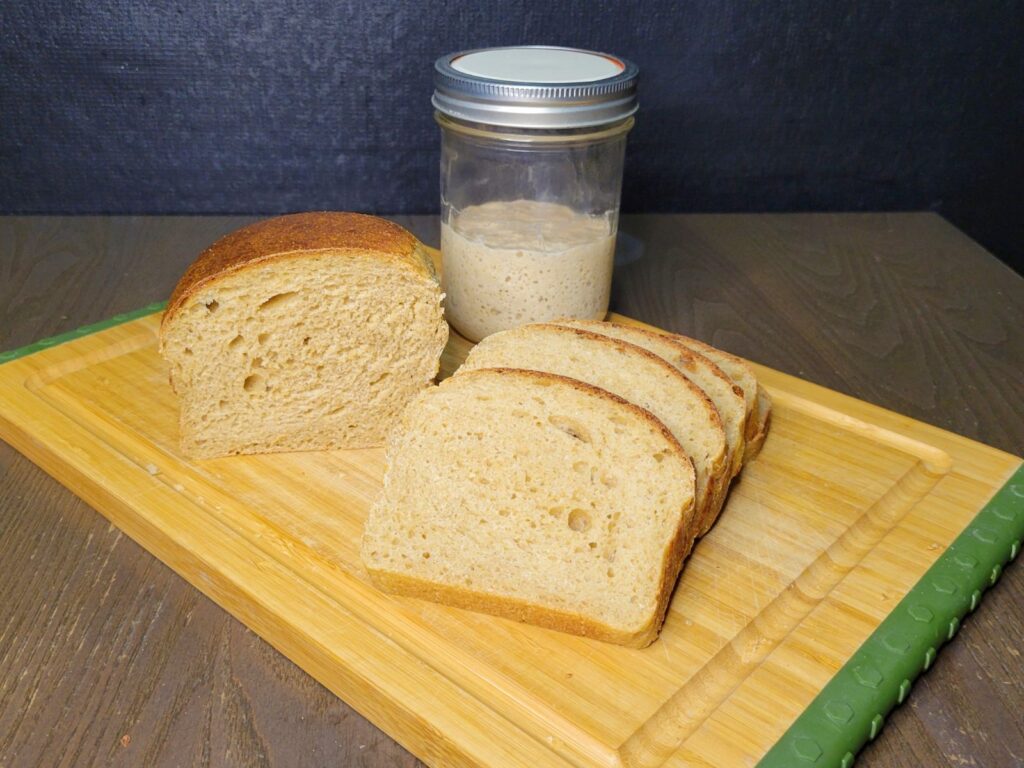
I actually really have been hesitant on putting this recipe out, along with other sourdough recipes, because sourdough made with fresh milled flour is very different than sourdough made with white flours. But, I decided I am here to help and share my knowledge of the things I have learned by my own experiments. So, here it is, one of the most requested recipes I am finally releasing!
So, there are some things I have learned along the way while experimenting and working with sourdough. Now, I am no professional sourdough baker, and there are many that are probably much better than I am. But, I get asked for sourdough recipes multiple times a day.

Why Does Sourdough Act So Differently With Fresh Milled Flour Than With White Flour?
The reason that sourdough is so different with fresh milled flour than it is with white flour is because freshly milled flour contains the WHOLE raw wheat berry with nothing added. If you do a side by side comparison as I have you will see that sourdough LOVES fresh milled flour so much that this is the very reason so many people are struggling with it when switching to fresh milled flour. The sourdough ferments much quicker! There are no additives, preservatives, or bleach there to slow or inhibit the good bacteria and yeast to be active. Also, Whole grain flours contain more natural yeast and bacteria compared to refined flours.

Why Are My Sourdough Rise Times So Different Than The Recipe?
There are so many variable to think about when we consider bread baking alone, but when you factor in sourdough starter in the mix, that is a whole new ballgame! Sourdough starter doesn’t always like to play by the rules, and sometimes has a mind of it’s own.
What Variables Affect My Sourdough Starter?
Some examples of variable that can affect sourdough starter:
- Water Temperature: The warmer the water, the quicker the sourdough will ferment & grow. BUT, if the water is too hot, it will kill your starter, and then there will be no growth!
- Temperature Of The Flour: When milling flour, it does get warm, so this plays a role in the fermentation of the sourdough. If you pre-milled the flour and it is kept in the freezer or fridge, then this will slightly slow down the growth time.
- Room Temperature: The temperature of your house will play a role in the time, and this can vary from day to day, and even from morning to night.
- Feeding Frequency: How often you refresh or feed the sourdough starter impacts its growth. Regular feedings help maintain its activity and strength. Also, the amount you feed will affect the strength of your starter.
- Starter Health: The balance of yeast and bacteria in the starter, influenced by regular feedings and maintaining a healthy environment, affects its growth rate.
- Air Quality and Environment: Factors like airborne microbes, humidity levels, and the cleanliness of the environment where the sourdough is kept can impact its growth.
- pH Levels: The acidity of the starter can influence the growth of specific microorganisms. A more acidic environment might favor certain bacteria and yeast strains over others.
- Starter Age: Young starters might need more time to develop strength and activity compared to well-established, mature starters.
Balancing these variables is part of the art of maintaining a healthy and active sourdough culture made with fresh milled flour. Small adjustments to any of these factors can impact the growth and performance of the starter.

You Can Do This!
I know this all sounds confusing, but once you start using it, you will start to learn how your starter behaves, and what is normal for it. These points are all just here to reference for troubleshooting and understand why your bake may have not turned out.
It is completely normal to have several failed bakes in the beginning, especially when using fresh milled flour. I came from baking beautiful almost perfect loaves of sourdough made with white flour too. I also thought it would be exactly the same, and I could just swap out my flour… right?
Wrong… I was soooo wrong! I had so many failed fresh milled four sourdough loaves that I actually gave up and threw my beloved sourdough started in the trash! (Please don’t hat me! I have learned from my mistakes!) I soon regretted this, because I missed it! So, I had to start a new one from scratch. And, this was not without difficulty. But, this is exactly how I learned the how’s, and the why’s about sourdough in relation to fresh milled flour. So, now I can share all this knowledge and my recipes with you, possibly saving you from years of anguish! LOL. But, please understand there will be fails, and there may be a lot! It’s ok, you can do this, just keep going!
I Am Here To Help!
So, let me share my recipe and techniques with you in my recipes, and videos. I have so many videos online that I share my tips and tricks. There you can see the texture, and consistency of my doughs, and it may help you visualize what I am saying.
I plan to release a video in the future if you want to create your own sourdough starter in the future from fresh milled flour, so make sure to subscribe to my Youtube Channel HERE so you don’t miss when I release that video this year. (Jan 2024, if you are reading this later, the video may already be released!)

Ingredients To Make Fresh Milled Flour Sourdough Sandwich Bread
- 4 & 1/2 cups Fresh Milled Flour 560g (My favorite is 450g hard white wheat & 110g Kamut)
- 1&1/2 cup room temperature water 360g
- 3 TBSP melted butter OR Olive Oil 42g
- 3 TBSP Sugar 36g OR Honey 60g
- 1&1/2 tsp salt 9g
- 1 egg room temperature
- 1/2 cup Sourdough Starter 115g
- *optional egg wash (1 egg+1 tsp water) for topping bread before baking
Instructions To Make Sourdough Sandwich Bread With Fresh Milled Flour
Preparing The Dough
- Firstly, make sure that you feed your sourdough starter the night before you want to bake with it. (Even if you already fed it in the morning. You want it nice and strong the night before.)
- Then, mill the flour. I like to use mostly hard white wheat with a little Kamut (Khorasan Wheat). Just make sure to use mostly hard wheat of some sort for this recipe. Otherwise, it will not develop the gluten enough to have a nicely risen loaf of bread.
- In a stand mixer, add water, melted butter (or oil), sugar (or honey), salt, and egg. Mix all these ingredients to combine.
- Then, add the freshly milled flour to the stand mixer, and start to mix slowly until all the dry flour is completely incorporated.
- Add the sourdough starter into the dough, and mix until incorporated. (The dough will seem very wet at this stage.)
- Cover, and let the dough sit at room temperature for a minimum of 15 minutes, or up to 1 hour. This resting time is important, It allows the fresh milled to start absorbing the liquid, and the bran to start softening. This is the Autolyse step.
Kneading
- After the dough has had time to Autolyse, then start the kneading process. This kneading process could take anywhere between 7 to 30 minutes. This time varies greatly, so the best way to tell if the dough is done being kneaded is to check the dough itself. You want a nice stretchy dough that wants to stay together. This is a wet dough, so try to resist adding flour to it. See video for the desired texture of dough that you are looking for.
- Once kneaded, cover the dough and let it rise until doubled. This can take anywhere from 2 to 8 hours depending on your sourdough starter, and how warm it is in your kitchen. (Other variables I mentioned above in my blog post can affect this rise time as well.) Mine generally takes about 3- 4 hours for example.
Shaping The Dough
- Prepare bread loaf pans with parchment paper.
- After the dough has doubled in size, then on a lightly oiled surface, cut the dough in half. This will make 2 small 1 pound loafs. See notes for other size bread pans. I use small 4×8 bread pans.
- Press each piece flat, then roll to shape, I show one shaping technique option in my video. But, make sure there is some surface tension, and no air pockets while rolling. it will be sticky so I recommend oiling your hands as well as the work surface.
- Place each loaf in the lined bread tin, and cover. Let rise this second time for 2-3 hours, or until it has risen and looks puffy. (Times may vary greatly, so make sure to check your dough occasionally during this second rise time.)
- During the end of this second rise preheat oven to 375*F.
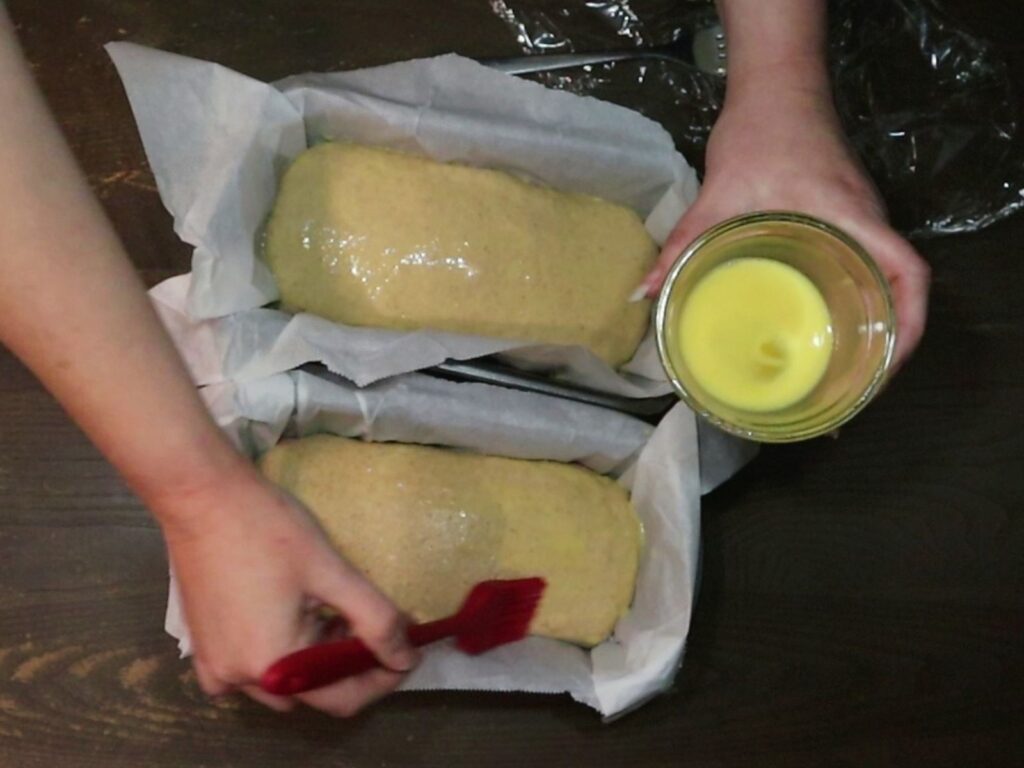
- Once the loafs have risen and look puffy, you can brush with an egg wash to make the loaf shiny and more browned. This step is optional.
Baking The Loaves
- Bake loaves for 35-40 minutes until the internal temperature of the center of the loaves are 205-210*F. If they are below this temp, the loaves may be gummy.
- Take bread out of the oven when the bread reaches that temp range. Then, remove them from the baking pans to a wire rack to cool. (The parchment papers can be used as handles so you don’t burn yourself.)
- Let the loaves cool completely before cutting into them! If you cut into them before they cool completely, they may be gummy on the inside.
- Once cooled completely, then slice to desired thickness, and enjoy!
Bread Pan Size
*Bread Pan Size Tips: My recipes call for the smaller 4×8 bread loaf pans, because I have a tiny oven! lol. Even the 4.5×8.5 pans are a bit larger, crazy how just that half inch each way can make such a difference! So, if you only have the larger pans, I recommend to x1.5 my recipes (except the sourdough starter, leave that the same) if you are looking for a large high rise loaf of bread. The large pans will definitely still work with this recipe as written, the loafs will just be a bit smaller. See Below for those measurements.
Larger Bread Pan Sizes
This recipe is for 2 small 4×8 loaves. However, I realize there are different pan sizes, so I wanted to give you the amounts for the two other most common bread pan sizes.
For Medium Bread Pan Size 4.5 x 8.5
- 7 cups Fresh Milled Flour 840g (I like to mill 700g hard white, and 140g Kamut)
- 2&1/4 cup Room temperature water 54og
- 4.5 TBSP Melted butter OR Olive Oil 63g
- 4.5 TBSP Sugar 60g OR Honey 90g
- 2&1/4 tsp Salt 13g
- 2 Eggs, room temperature
- 3/4 cup Sourdough Starter 174g
- *optional egg wash 1 egg+1 tsp water for topping bread before baking
For Large Bread Pan Size 5 x 9
- 9 cups Fresh Milled Flour 1,120g (My favorite is 900g hard white wheat & 220g Kamut
- 3 cups Room temperature water 720g
- 6 TBSP Melted butter OR Olive Oil 84g
- 6 TBSP Sugar 72g OR Honey 120g
- 3 tsp Salt 18g
- 2 Eggs, room temperature
- 1 cup Sourdough Starter 230g
- *optional egg wash 1 egg+1 tsp water for topping bread before baking
How To Store Sourdough Sandwich Bread Made With Fresh Milled Flour
To store this fresh milled flour sourdough sandwich bread, keep in an airtight container, or bag. You can keep these on the counter for 2-3 days. For longer storage, place in a freezer safe bag and freeze for up to 4 months. (Make sure the loaf has cooled completely before freezing, best results to freeze the same day as it is baked.) To thaw, sit on the counter, and let come to room temperature.
Make Your Own Sourdough Starter From Scratch With Fresh Milled Flour
If you don’t already have a sourdough starter, but are wanting to make one with 100% fresh milled flour from scratch, I am here for you! I have a video resource that goes over how you can make your very own sourdough starter using only freshly milled flour. I also go over troubleshooting issues to help make this process a little easier for you, and I make a brand new sourdough starter right along side you! You can watch that video HERE.
I also have a written blog post that covers this information, if you would like to print it out and have it handy for when you are just getting started. You can do this, it is not as difficult as some on the internet have made it seem! You can checkout my blog post about it HERE.
Shop This Post
Grain mill Nutrimill (Use Coupon Code: Grainy for $20 Off yours)
Hard White Wheat (Small Amount)
Kamut (Small Amount)
Check Out Some Of My Other Recipes
How To Make Your Own Sourdough Starter With Fresh Milled Flour
Brown Butter Sourdough Chocolate Chip Cookies
Peppermint Chocolate Sourdough Cupcakes
How To Transition Your Sourdough Starter To Fresh Milled Flour
Fresh Milled Flour Recipe Index

Sourdough Sandwich Bread Made With Fresh Milled Flour Printable Recipe

Sourdough Sandwich Bread Made With Fresh Milled Flour
Equipment
- 2 4×8 bread pans *See Notes for Larger Bread Pan Ingredient List
- 1 digital thermometer to check to see when the loaves are done
Ingredients
- 4&1/2 cups Fresh Milled Flour 560g My favorite is 450g hard white wheat & 110g Kamut
- 1&1/2 cup Room temperature water 360g
- 3 TBSP Melted butter OR Olive Oil 42g
- 3 TBSP Sugar 36g OR Honey 60g
- 1&1/2 tsp Salt 9g
- 1 Egg, room temperature
- 1/2 cup Sourdough Starter 115g
- *optional egg wash 1 egg+1 tsp water for topping bread before baking
Instructions
- Firstly, make sure that you feed your sourdough starter the night before you want to bake with it. (Even if you already fed it in the morning. You want it nice and strong the night before.)

- Then, mill the flour. I like to use mostly hard white wheat with a little Kamut (Khorasan Wheat). Just make sure to use mostly hard wheat of some sort for this recipe. Otherwise, it will not develop the gluten enough to have a nicely risen loaf of bread.
- In a stand mixer, add water, melted butter (or oil), sugar (or honey), salt, and egg. Mix all these ingredients to combine.
- Then, add the freshly milled flour to the stand mixer, and start to mix slowly until all the dry flour is completely incorporated.
- Add the sourdough starter into the dough, and mix until incorporated. (The dough will seem very wet at this stage.)

- Cover, and let the dough sit at room temperature for a minimum of 15 minutes, or up to 1 hour. This resting time is important, It allows the fresh milled to start absorbing the liquid, and the bran to start softening. This is the Autolyse step.
- After the dough has had time to Autolyse, then start the kneading process. This kneading process could take anywhere between 7 to 30 minutes. This time varies greatly, so the best way to tell if the dough is done being kneaded is to check the dough itself. You want a nice stretchy dough that wants to stay together. This is a wet dough, so try to resist adding flour to it. See video for the desired texture of dough that you are looking for.

- Once kneaded, cover the dough and let it rise until doubled. This can take anywhere from 2 to 8 hours depending on your sourdough starter, and how warm it is in your kitchen. (Other variables I mentioned above in my blog post can affect this rise time as well.) Mine generally takes about 3- 4 hours for example.
- Prepare bread loaf pans with parchment paper.
- After the dough has doubled in size, then on a lightly oiled surface, cut the dough in half. This will make 2 small 1 pound loafs. See notes for other size bread pans. I use small 4×8 bread pans.
- Press each piece flat, then roll to shape, I show one shaping technique option in my video. But, make sure there is some surface tension, and no air pockets while rolling. it will be sticky so I recommend oiling your hands as well as the work surface.
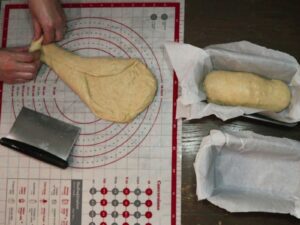
- Place each loaf in the lined bread tin, and cover. Let rise this second time for 2-3 hours, or until it has risen and looks puffy. (Times may vary greatly, so make sure to check your dough occasionally during this second rise time.)
- During the end of this second rise preheat oven to 375*F.
- Once the loafs have risen and look puffy, you can brush with an egg wash to make the loaf shiny and more browned. This step is optional.

- Bake loaves for 35-40 minutes until the internal temperature of the center of the loaves are 205-210*F. If they are below this temp, the loaves may be gummy.
- Take bread out of the oven when the bread reaches that temp range. Then, remove them from the baking pans to a wire rack to cool. (The parchment papers can be used as handles so you don’t burn yourself.)
- Let the loaves cool completely before cutting into them! If you cut into them before they cool completely, they may be gummy on the inside.
- Once cooled completely, then slice to desired thickness, and enjoy!

Video
Notes
For Medium Bread Pan Size 4.5 x 8.5
-
- 7 cups Fresh Milled Flour 840g (I like to mill 700g hard white, and 140g Kamut)
-
- 2&1/4 cup Room temperature water 540g
-
- 4.5 TBSP Melted butter OR Olive Oil 63g
-
- 4.5 TBSP Sugar 60g OR Honey 90g
-
- 2&1/4 tsp Salt 13g
-
- 2 Eggs, room temperature
-
- 3/4 cup Sourdough Starter 174g
-
- *optional egg wash 1 egg+1 tsp water for topping bread before baking
For Large Bread Pan Size 5 x 9
-
- 9 cups Fresh Milled Flour 1,120g (My favorite is 900g hard white wheat & 220g Kamut)
-
- 3 cups Room temperature water 720g
-
- 6 TBSP Melted butter OR Olive Oil 84g
-
- 6 TBSP Sugar 72g OR Honey 120g
-
- 3 tsp Salt 18g
-
- 2 Eggs, room temperature
-
- 1 cup Sourdough Starter 230g
-
- *optional egg wash 1 egg+1 tsp water for topping bread before baking
*This post contains affiliate links, which means I make a small commission at no extra cost to you! As an Amazon Associate I earn from qualifying purchases. But, I will only suggest items I actually Love and Have Used!



In the past I made a sourdough sandwich bread recipe that added a tsp of active yeast in addition to the sour dough starter to shorten the rise time. (It was not made with fresh milled flour). Would adding a tsp of yeast to this recipe expedite the rise time or would it ruin the recipe? I have yet to try this recipe or successfully make a sourdough sandwich bread with fresh milled flour…but I am determined to learn this. 🤪
You could add it, but fresh milled flour sourdough tends to ferment much faster than white flour sourdough. So, with a strong starter, my dough usually only rises around 4 hours give or take, then again for about 2 hours second rise.
Great recipe! I had to tweak the kneading process because my 6 qt kitchen aid doesn’t seem to handle the dough well. Because the dough is so sticky I had to go in scraping the bowl so many times. I let it knead for a while til the gluten has formed mostly then went in with some extra stretch and folds 30ish mins apart. Worked out well!
I am glad it worked out great! Yes, fresh milled flour can give a mixer a pretty good workout, sounds like you adapted perfectly for it! 🙂
Have you ever used spelt instead of Kamut in this recipe?
Yes, I have used spelt, and enjoy it as well. But, with spelt you will need a bit more of it than you would if it were Kamut.
I am done with trying to bake sourdough. I followed the recipe exactly for the sourdough sandwich bread. This was the 3rd try to make it. The starter was beautiful with lots of bubbles. Everything seemed to be going great, but once they went into the baking pans, the dough never would rise. I finally hit me that this is crazy. I live alone and can eat my regular FMF bread. I have no need for sourdough. I am paying a lot of money for something that isn’t necessary. Not your fault. Perhaps it has something to do with high altitude of close to a mile high. Do you have a suggestion of what I can do with these flat breads that I baked? They taste good.
You can dry and blend them into bread crumbs, and use in things like meatloaf, meatballs, and breading for chicken or a different meat. Also, they taste great cubed up and made into croutons. Here is my crouton recipe if you want to give it a try. https://grainsinsmallplaces.net/easy-homemade-croutons/
How much (and what) do you feed your Starter?? I’ve seen so many different amounts and ingredients, I’m confused! (Thank you!)
I have a whole video on starting a sourdough starter that may help. I also make one along side of you. https://youtu.be/lrxGfDPM8Fo
Hi Kara. Looking forward to trying this recipe, I love your yeast burger buns, so I expect that I’ll like this too. Love that even your sourdough recipes are done in one day, and NOT so sour. Question: your written recipe above says to bake at 375 F, but in the video you bake it at 400 F. Which do you think works best? Thanks!
Awesome! I am so glad you are enjoying my recipes! I used to bake my breads at a higher temp for a shorter time, but Many reported more success with a little lower temp, and longer time. So, now I bake with the 375*F longer with better results! I hope that helps. Happy Baking! 🙂
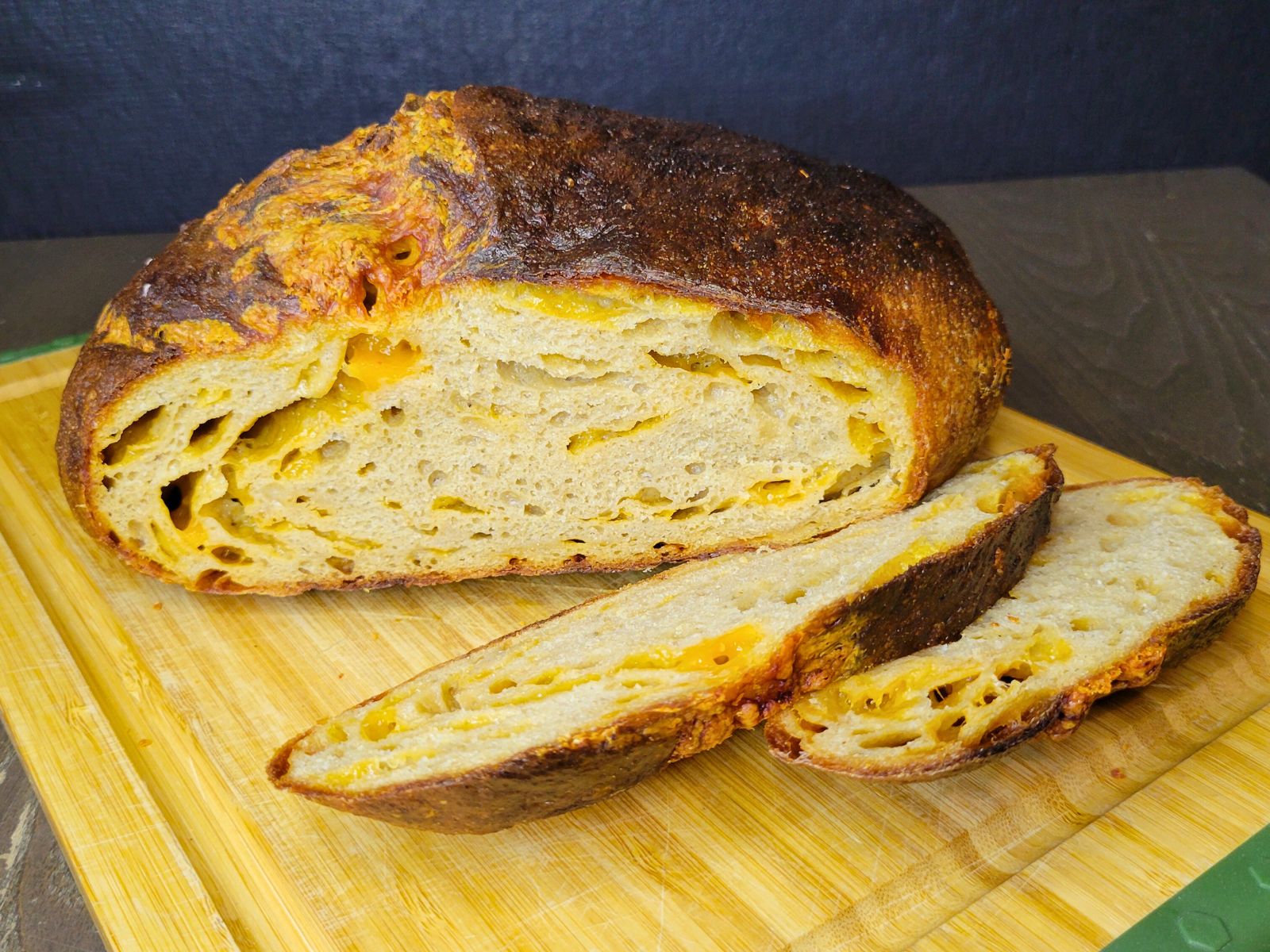
I’ve tried this once before and loved it! I was wondering if you could do inclusions in this bread? I’m wanting to try to make a jalapeño cheddar loaf with the sandwich bread.
Yes! you can, I actually have a cheddar sourdough boule recipe, you can absolutely also add in jalapeños in it as well. https://grainsinsmallplaces.net/cheddar-cheese-sourdough-bread-made-with-fresh-milled-flour/
I have made that recipe and loved it! I added cheddar and jalapeño and will be making it again! Thank you!
Awesome! Glad to hear it! 🙂
I love this recipe! I’ve used it many, many times. I usually forget to feed my starter the night before. If you forget, it does work to make the dough in the morning anyways, let it sit out and ferment during the day, then shape into loaves and stick into the fridge overnight. The next morning, I take mine right from the fridge and put into the oven. A favorite variation is sprinkling on rosemary, sea salt, and sesame after I pat it out for shaping.
Thanks so much for sharing! Sounds delicious! 🙂
Supposing I do not add an egg, would the recipe work with no additional changes? Just got my grain mill today and I’m so happy I found your website and YT channel. Thank you!
Yay! I am so happy you found me too! You can omit the egg, just watch the moisture level of the dough to match closely to mine in the video. If it seems too dry, you can add a bit more liquid, but you can add that later, it may be fine without. Let me know how it goes! 🙂
I did sub the sugar for less honey. It turned out fantastic, nice, and soft. The crust wasn’t hard, which was a big plus. Thank you!
Awesome! I am so happy to hear that! Thanks so much!:)
What speed do you put your mixer at when bringing the dough together?
I usually use speed 2 on my Bosch, or about the 2-3 o’clock position on my Ankarsrum.
I have made this recipe many times! It’s wonderful! Thank you for sharing your wonderful fresh milled flour recipes with us.
Awesome! I am so happy to hear that! Thank you so much! 🙂
HOLY SOUR SOURDOUGH! The texture of this stuff is amazing! And I did screw up and not read the ENTIRE recipe before beginning and did do a little bit of Einkorn before I read that it’s not a good idea. Why is it SO sour? I actually like it really sour, but wow! I’ve made regular sourdough with my FMF starter and not had it be like this. My dough did take forever to rise because my house is like an igloo, so maybe that’s why? Definitely can see why you said NOT to bulk ferment like usual. That would be over the top. Going to try and again today use Kamut and put the dough outside to rise and see if that takes the sour down a touch. But all in all! It’s a win! Very happy!
If it’s super sour, then that could be your starter. Try feeding it very heavy a couple feedings before baking with it. Somehow it must have gotten too acidic sometimes that happens if in the fridge too long between feedings. fresh milled flour ferments super quickly
Hello there! I love every recipe of yours that I have tried and even ordered your cookbook for myself and my DIL because I trust the accuracy of your recipes. Now that I have the Bosch mixer and can make larger batches, I’m wondering about doubling the large batch ingredients of this particular recipe; do you have any suggestions?
Yay! Thank you so much! Yes, you can double this recipe, anymore than double, I would only add a touch more than double the sourdough starter so it doesn’t over ferment.
I am new to fresh milled flour and sour dough and it’s been a big learning curve. This recipe was the first one that was soft and fluffy and so delicious! Thank you thank you!
I watched your video and did each step with you. Appreciate your instructions and how thoroughly you explain what you’re doing.
Yay! So glad to hear it was a hit! Thank you! 🙂
Can you easily double this recipe to make 4 loaves?
Yes, you can double this! 🙂
I enjoy this recipe but I’m wondering if fresh milled spelt could be used instead of kamut. Can I use my Ank with hard white and spelt? Thanks!
You can use spelt in place of Kamut, BUT I would hold back a little of the liquid in the recipe. Kamut is a very thirsty grain, so when subbing it out, sometimes you don’t need as much water. If the dough looks a little dry, you can always add the liquid in later.
Can I do stretch and folds instead? I have a kitchenaid and can’t seem to get a windowpane with it
You can do stretch and folds, but I still recommend a little kneading to get the dough nice and stretchy.
Hi, i want to try this but what if I want this to be more savory instead of sweet? Can I omit the honey and what other adjustment should I make to the liquid ratio if so? Thank you!!
Yes, you can omit the honey, if the dough seems dry, you can add a tiny bit of water.
Hi! I love all your recipes! Totally married to the Tangzhone breads. We eat 2 loaves a week religiously!
I’d love to try this recipe but I just want to make the original small batch… BUT make 1 large loaf and just make rolls or a tiny loaf outta the extra as a test run. Do we know the weight of the dough or maybe should I just use 3/4 of the dough from the base recipe for a 9×5 pan?
Yay! I have been loving the Tangzhong method too! This recipe makes 2 pretty small loaves, or you could do one 4.5×8.5 loaf with about 3/4 of the dough, and make some rolls with the rest.