

Everyday Sandwich Bread made with Fresh Milled Flour : Easy Recipe
This Everyday Sandwich Bread made with Fresh Milled Flour is an Easy, beginner friendly Recipe. I will walk you through each step of the way, and I have video instructions HERE where you can watch me make this exact bread along with some other goodies too! I believe that homemade is usually better, especially when it comes to bread. Also, I want to show you how to make a delightful everyday sandwich bread using fresh milled flour. By using this wholesome and nutritious ingredient, you’ll not only enhance the flavor and texture but also add an extra dose of nutrition to your sandwiches. So, Let’s get started!
*Updates To Post
*This post was updated to modify the original baking temperature and time, I find the slight cooler temp with longer bake time works better for most ovens. (The original bake time for this Fresh Milled Flour Sandwich Bread was 400*F, but I have updated it to 350*F for a longer bake time.)
*I also updated the post to include the alternative pan sizes, and how to alter the Fresh Milled Flour Sandwich Bread recipe for each size.

Can I Make This Fresh Milled Flour Sandwich Bread With Sourdough Instead Of Yeast?
Yes! This recipe can be made with sourdough rather than yeast. I have that recipe and method on my website as well! HERE is my Sourdough Sandwich Bread Recipe made with freshly milled flour.
Making Sandwich Bread With Fresh Milled Flour
Making Sandwich bread with fresh milled flour is no easy feat when you are first learning. Even if you are an experienced baker for many many years, fresh milled flour is a whole new ballgame! When I started baking with fresh milled flour, years ago, everything I knew about baking with white flour went out the window. All the tricks I thought I knew didn’t work. And all those “Golden Rules” I always abided by just ended in failure after failure. So, this made me even more determined to figure out why and what I needed to do to change this into success! I was determined that I could create light fluffy loafs just like the sandwich bread I bought at the store…..But better!

Learning To Master Fresh Milled Flour Sandwich Bread
When I was learning, there was very little information out there only a couple resources, and slim to no recipes written specifically for freshly milled flour. I had to figure out, all by trial and error how to master this! Once I began working with fresh milled flour more and more, I began to learn and grow. This is when I decided I should try to teach others everything I have learned. My inspiration bloomed into a Youtube channel, and Blog. I never thought I would do either of those (I am quite introverted), but the calling was just there I guess. So, I just needed to step out of my comfort zone!
I teach tips and tricks in most all of my videos, and blog posts. I am continuing to write new recipes often to share with the world. All of them with exclusively fresh milled flour. I have a passion to spread the word, and teach people how much healthier whole grains are. Also, I want to help people learn what they are putting in their foods, and in turn putting in their bodies.
Switching From White Flour To Fresh Milled Flour
Firstly, don’t start out changing everything at once! It will be difficult to do, as there is a learning curve, and tastebud curve as well. (If that is even such a thing.) Take it slow, and work on mastering one bread, and one or two other non bread recipes. Once you master one bread recipe you will start to develop a feel for how it should look, feel, and move. (*hint I will post a couple great starter bread recipes (other than this one, of course) at the end of this post.) I know it is exciting to try all sorts of new recipes, but often times when people do this, they just think they don’t like fresh milled flour, and stop using it. I promise it will all come to you in due time.

What Pan Size Should I Use?
My recipes call for the smaller 4×8 bread loaf pans, because I have a tiny oven! lol. Even the 4.5×8.5 pans are a bit larger, crazy how just that half inch each way can make such a difference! So, if you only have the larger pans, I recommend to x1.5 my recipes if you are looking for a large high rise loaf of bread. The large pans will definitely still work, the loafs will just be a bit smaller. HERE is a link to the smaller bread pans I use.

Ingredients To Make This Fresh Milled Flour Sandwich Bread
Bread Pan Size 4×8
- 4 cups Fresh Milled Flour 485g (I like to mill 405g hard white, and 80g Kamut)
- 3/4 cup water 180g
- 3/4 cup milk 180g
- 3 TBSP Butter 42g
- 3 TBSP Sugar or Honey 63g
- 1&1/2 tsp salt
- 1 egg 50g
- 2 tsp instant yeast
Medium Bread Pan Size 4.5×8.5
- 6 cups Fresh Milled Flour 728g (I like to mill 608g hard white, and 120g Kamut)
- 1&1/8 cup water 270g
- 1&1/8 cup milk 270g
- 4&1/2 TBSP Butter 63g
- 4&1/2 TBSP Sugar or Honey 94g
- 2&1/4 tsp salt
- 2 eggs 100g
- 3 tsp instant yeast
Large Bread Pan Size 5×9
- 8 cups Fresh Milled Flour 970g (I like to mill 810g hard white, and 160g Kamut)
- 1&1/2 cup water 360g
- 1&1/2 cup milk 360g
- 6 TBSP Butter 84g
- 6 TBSP Sugar or Honey 126g
- 3 tsp salt
- 2 egg 100g
- 4 tsp instant yeast
Instructions To Make Fresh Milled Flour Sandwich Bread
- Firstly, Mill the flour
- Then, to a microwave safe bowl add water, milk, and butter and microwave until the butter is melted completely.
- Add water/milk/butter mixture to stand mixer bowl, then add sugar, egg, and salt. Mix to combine.
- Then, add flour to the stand mixer, and start to mix until all the dry flour is gone.
- Cover and let it sit at room temperature for at least 15 minutes, up to 2 hours to allow the fresh milled flour to absorb the liquid.
- Then, add the instant yeast. Start to mix the yeast in until combined.
- Start the kneading process. This could take 25 minutes with fresh milled flour, or less. This varies greatly, so the best way to check if the dough is done being kneaded, is to check for a window pane test. Window Pane Test Video HERE
- Once a successful window pane test is done, then, cover the dough and let it rise until doubled. This will typically take 1 to 2 hours.
Shaping The Loaf
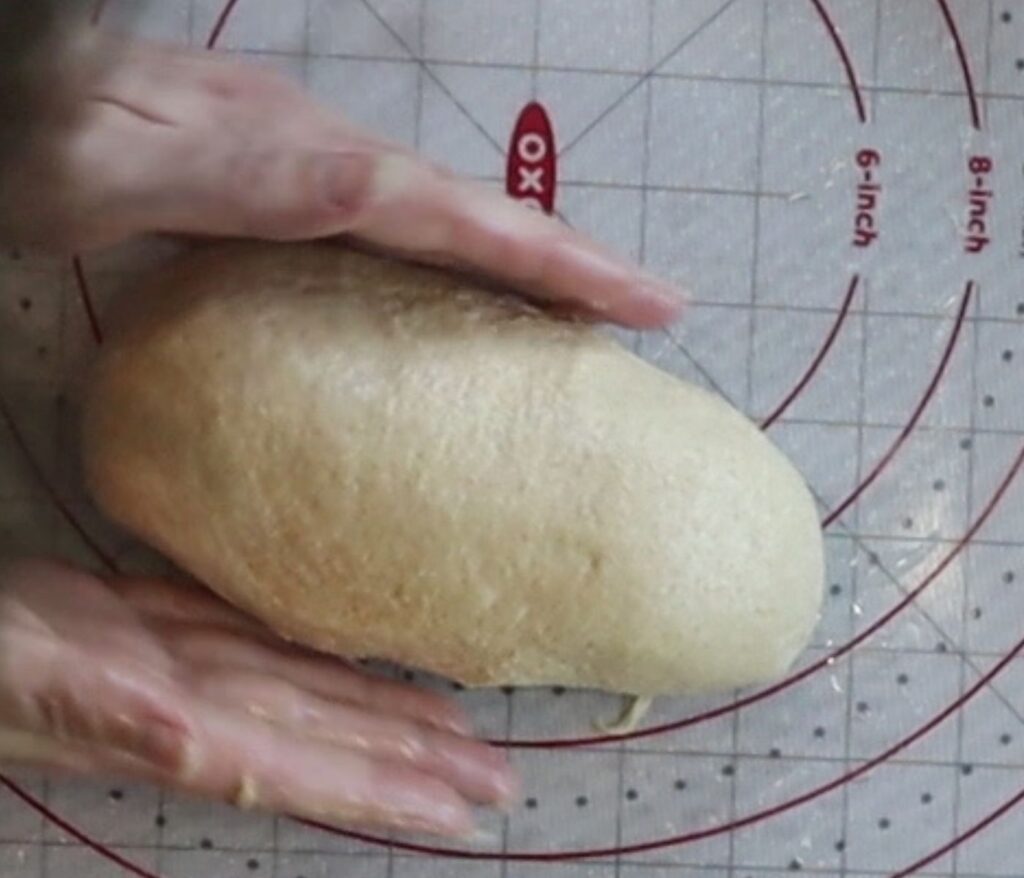
There are so many ways to shape a loaf of bread, but the most important thing is to make sure you have good surface tension.
- After the dough has doubled in size, then, divide the dough in half if you are making 2 one pound loaves. Press each piece flat, then roll up to shape. Make sure there is some surface tension, see my video for shaping if you are interested HERE
- I like to use some oil on my hands and work surface to help with the wetter stickier dough.
- Place in a parchment paper lined 4×8 bread pan, and cover for about 40 minutes until puffy looking.
- Preheat oven to 350*F towards the end of this second rise time.
- Bake for 30 to 40 minutes until the internal temperature reaches 190*F.
- Take bread out of the oven, and out of the bread tins right away, and place them on a wire cooling rack.
- Let cool for at least one hour before slicing.
- Slice to desired thickness, and enjoy!
Using Hard White Wheat & Kamut To Make Sandwich Bread
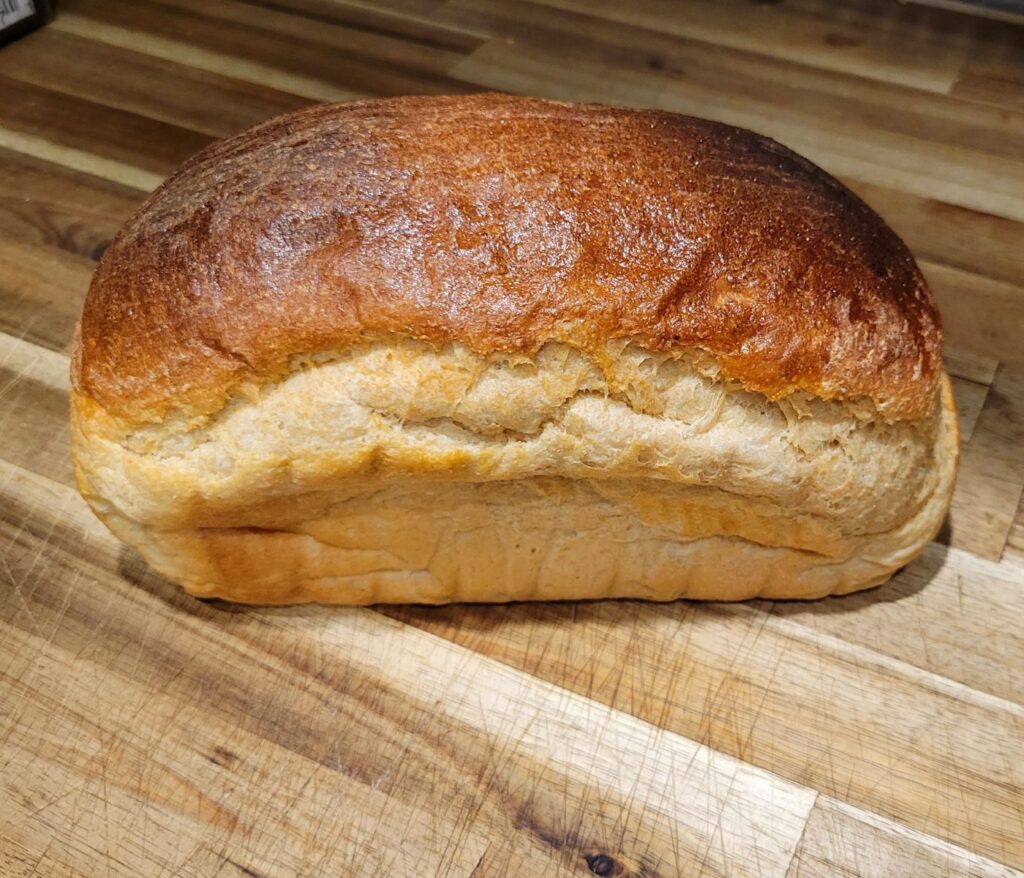
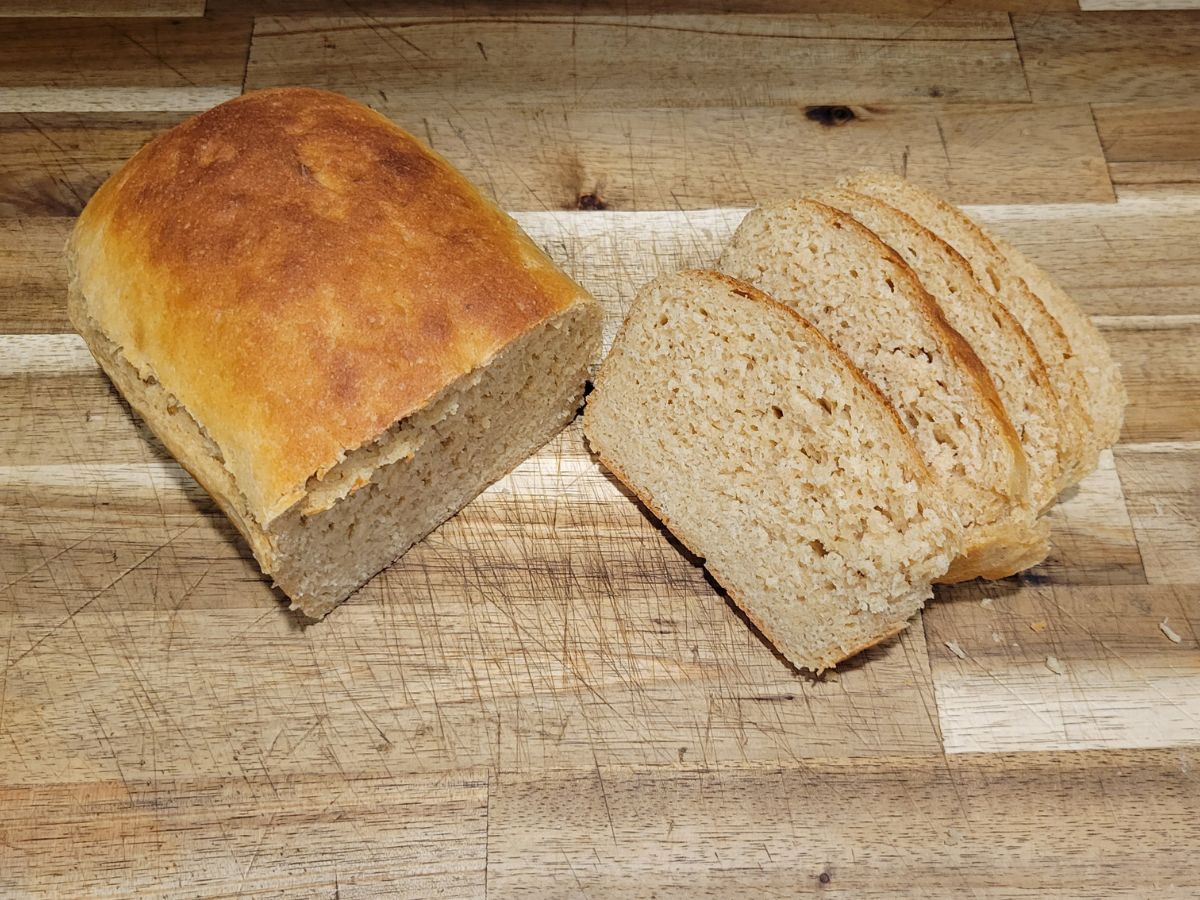
Indulge in the epitome of homemade perfection with this captivating slice of bread. Expertly crafted using a combination of predominantly hard white wheat and a delightful hint of Kamut, this sandwich bread is a true marvel made with freshly milled flour. Prepare to experience the utmost softness and irresistibly squishy texture, all while savoring the wholesome essence of 100% whole grains. Brace yourself for a taste sensation that redefines what homemade bread can truly be

Enjoy That Bread!
With this simple and rewarding recipe, you can easily create a delicious everyday sandwich bread using freshly milled flour. The wholesome goodness and aromatic flavors will elevate your sandwiches to a whole new level. Say goodbye to store-bought bread and enjoy the satisfaction of homemade goodness. Happy baking!
How To Store Fresh Milled Flour Sandwich Bread
To store these fresh milled flour sandwich bread loafs, keep in an airtight container, or bag. Then, keep on the counter for 2-3 days. For longer storage, place in a freezer safe bag and freeze for up to 4 months. (Make sure the loaf has cooled completely before freezing, best results to freeze the same day as it is baked.) To thaw, sit on the counter, and let come to room temperature.
Shop This Post
Toaster Oven With Proofing Function
My Suggested Beginner Bread Recipes
Simple Sandwich Bread – No eggs, milk, or butter
No Knead Overnight Yeast Bread
My 4 Ingredient Bread – Italian Baguette Style (no loaf pan required)
Focaccia – If you are struggling to get the dough right for any Fresh Milled Flour Bread, or have questions, I highly recommend my FREE Masterclass on Youtube, HERE
Once These Are Mastered, I have some level 2 breads to try out!
Sourdough Sandwich Bread Made With Fresh Milled Flour
Cheesy Garlic Pull Apart Bread
And, here is My Fresh Milled Flour Recipe Index updating each week with new ones! You can find cookies, cupcakes, Sourdough, Pasta, muffins, waffles, and more all made with 100% fresh milled flour!

Fresh Milled Flour Everyday Sandwich Bread
Equipment
- 2 4×8 bread pans
Ingredients
For Smaller Bread Pans 4×8
- 4 cups Fresh Milled Flour 485g I like to mill 405g hard white, and 80g Kamut
- 3/4 cup water 180g
- 3/4 cup milk 180g
- 3 TBSP Butter 42g
- 3 TBSP Sugar or Honey 63g
- 1&1/2 tsp salt
- 1 egg 50g
- 2 tsp instant yeast
For Medium Bread Pan Size 4.5 x 8.5
- 6 cups Fresh Milled Flour 728g I like to mill 608g hard white, and 120g Kamut
- 1&1/8 cup water 270g
- 1&1/8 cup milk 270g
- 4&1/2 TBSP Butter 63g
- 4&1/2 TBSP Sugar or Honey 94g
- 2&1/4 tsp salt
- 2 eggs 100g
- 3 tsp instant yeast
For Large Bread Pan Size 5 x 9
- 8 cups Fresh Milled Flour 970g I like to mill 810g hard white, and 160g Kamut
- 1&1/2 cup water 360g
- 1&1/2 cup milk 360g
- 6 TBSP Butter 84g
- 6 TBSP Sugar or Honey 126g
- 3 tsp salt
- 2 egg 100g
- 4 tsp instant yeast
Instructions
- Firstly, Mill the flour
- Then, to a microwave safe bowl add water, milk, and butter and microwave until the butter is melted completely.
- Add water/milk/butter mixture to stand mixer bowl, then add sugar, egg, and salt. Mix to combine.
- Then, add flour to the stand mixer, and start to mix until all the dry flour is gone.
- Cover and let it sit at room temperature for at least 15 minutes, up to 2 hours to allow the fresh milled flour to absorb the liquid.
- Then, add the instant yeast. Start to mix the yeast in until combined.
- Start the kneading process. This could take 25 minutes with fresh milled flour, or less. This varies greatly, so the best way to check if the dough is done being kneaded, is to check for a window pane test.
- Once a successful window pane test is done, then, cover the dough and let it rise until doubled. This will typically take 1 to 2 hours.
- After the dough has doubled in size, then, divide the dough in half. I like to use some oil on my hands and work surface to help with the wetter stickier dough.
- Press each piece flat, then roll up to shape. Make sure there is some surface tension.
- Place in a parchment paper lined 4×8 bread pan, and cover for about 40-50 minutes until puffy looking.
- Preheat oven to 350*F towards the end of this second rise time.
- Bake for 30 to 40 minutes until the internal temperature reaches 190*F.
- Take bread out of the oven, and out of the bread tins right away, and place them on a wire cooling rack.
- Let cool for at least one hour before slicing.
- Slice to desired thickness, and enjoy!
Video
Notes
*This post contains affiliate links, which means I make a small commission at no extra cost to you! As an Amazon Associate I earn from qualifying purchases. But, I will only suggest items I actually Love and Have Used!

Why do I keep getting air bubbles in my bread dough.
It could be the shaping, OR if it over proofs, it can make large bubbles at the top of the loaf, and the loaf will start to collapse after or even during baking. If this is the case, try shortening your second rise time. If it isn’t from the proofing, I would suspect the shaping, Here is a short video I made on shaping a loaf that may help. https://youtube.com/shorts/-igyZHChw7A
Thank you for your video and the recipe. It has helped me to know when my dough is done kneading. Can you help me figure out why my bread crumbles easily, especially near the top of the slice? When we try to spread peanut butter it just falls apart, or sometimes when we eat it with mayonnaise and cold slices it will fall apart easily while we are holding the sandwich. I feel pretty confident that I’m getting a good window pane when kneading. I’m using about 75% hard red wheat with the rest being hard white. The bread does not collapse when I remove it from the oven, but I can’t think of any other possibility other than my rise time. Any thoughts?
If it is crumbly near the top of the loaf, this is usually an indication that the loaf over proofed. To fix this, try shortening your second rise. Let me know how it goes.
Also, here is my sandwich bread with the Tangzhong method which makes a pretty big difference in the texture of the bread, and it holds together better. https://youtu.be/uvHXu3R6WH8
Just tried this recipe, I’ve had a lot of success with your recipes so far, but this was brutal. It was SO sticky and wet, and didn’t fully windowpane after 45 minutes of kneading in a kitchen aid, checking every 10 minutes, It rose fine, lots of bubbles, but when I went to split it, it was like glue, and I had to dump tons of flour in it just to get it to work, oil did nothing to prevent the sticking. It’s on the second rise now, I’m sure I’ll get something out of it, but I’d love some input for future attempts. FYI, I used the 9 x 5 scale recipe, exact grain measurements for hard white and Kamut. Thanks!
It should be a little wet and sticky, but I do have a video on adjusting if it seems to be too wet that may be helpful. https://youtu.be/tdnCrbOsVag
This has become my failsafe sandwich bread recipe for sourdough. Turns out great every time!
I am about to receive my Bosch mixer and wonder about making a larger batch to make more loaves at once. Have you done this before? If so, do you have any measurements and tips or tricks for doubling or tripling the large loaves recipe?
Yay! So glad to hear that! I have doubled the recipe with great results. I have not tried a larger batch than that. Let me know how it goes if you give it a try. 🙂
Hi Kara,
This is my very first attempt at fresh milled bread. I have some milk powder that I’d like to use up (in place of the milk) and was wondering whether that will mess up the recipe? It calls for milk powder + water–will the milk powder mess up the dry ratio?
You can use the milk powder with the same amount of water to “turn it into milk” without changing the recipe.
I have tried so many recipes… This recipe checked all the boxes! I love the texture, the crust and the flavor. I ground my hard red wheat on level 1 of my Mockmill. (Last round, I accidentally ground it in level 10 – the mill is new to me, so still getting used to it!)… One side note…. I added 1-2 cups more flour in the kneading process. I kneaded it both with my Kitchen Aid and then by hand. Delicious!!! Thank you for sharing this recipe! It’s will be my weekly go to!
Glad this was a hit! Thanks! 🙂
Hey There! I have bought your book and have been trialling out my new mill lately. I’m happy with all the sweets, wraps, pizza doughs etc but I cannot seem to get the bread right! I’m so dis heartened as I was an avid sourdough baker! I’ve given up on sourdough, and focussing on getting yeasted bread right.
Can you cook these in a cast iron bread pan? Would I need to proof in something different to preheat the pan? would you recommend just making in smaller tins first?
I also use a kitchenmaid for mixing with dough hook. I Have to put an ice pack on the top to keep the mixer cool. Do people have success with kitchenaid?
Hi, thank you so much! Yes, you can make this in a cast iron bread pan, I would use the small size and put all the dough into one pan. The baking time will be longer in this case because of more dough. You can proof in the cast iron bread pan, yes. The kitchen aids do struggle sometimes with fresh milled flour doughs. I do have a video that talks about some tips when working with a kitchen aid that may help here- https://youtu.be/tdnCrbOsVag
I hope that helps! Let me know how it goes. 🙂
If you are using the instant yeast, are you just putting that straight into the dough after it sits for two hours and then needing it or are you putting it into liquid first to bubble?
For instant yeast, I just put the yeast into the dough after the autolyse period
I’ve been making this every week for a year and I haven’t bought bread since! Thank you so much for this recipe and your website.
I want to start incorporating more flaxseed into my family’s diet, is there a way I could do that with this recipe without making the bread crumbly?
Glad to hear it has become a staple! Yay! Yes, you can add some flax seeds right into the dough. It does absorb quite a bit of moisture, so just watch to make sure you don’t need to add any more water to the dough. I also have this seedy baguette style loaf recipe for a free-form flax seed bread too! https://grainsinsmallplaces.net/seeded-bread-with-fresh-milled-flour/
Why are the edges and bottom of the loaf dense and the middle soft and fluffy.
It could be the pan you are baking it in, or the second rise was too long or even too short can cause that as well.
I use stoneware loaf pans from Pampered Chef. I do line them with paper.
Can this be made using Buttermilk for the milk?
Yes, you can swap out the milk.
Made the 4×8 pan loaf. I think I am misunderstanding something. Is this recipe for two loaves in the size pan you have listed? My bread turned out great in one 4×8 loaf pan. But I bought new pans today and they are 9×5 and I want to make sure I do this right.
Yes, each recipe size is for two loaves in the stated pan sizes. So to make 2 loaves in your new 5×9 pans, you would use the largest recipe size listed in the recipe. 🙂
Thank you for including the fact that it may take up to 25 minutes of kneading. I have been adding more flour only after about 5 minutes until the dough cleaned the sides of the bowl. I let it go almost the full 25 minutes with this recipe and the dough was cleaned the sides of the bowl without any additional flour.
Yes, try to hold back from adding any additional flour and give it some time! Nice Job! Thanks! 🙂
I need some help. The first time I made this bread, it turned out great. It was easy to slice. I could use it to make sandwiches. The last two times I made it, the bread fell apart. The dough seems overly wet. I can’t remember what the dough looked like the first time I made it. One time I kneaded for probably 45 minutes, and it still seemed wet. I figured I over kneaded that one. Today I tried again, and I kneaded much less using a Kitchen Aid mixer. It was very, very sticky and didn’t resemble your video. I don’t know how to get the dough to look smooth. Should I add more flour?
I would recommend holding back a bit of the liquid from the recipe, and only putting it in if the dough seems tight or dry. Here is a video I made to help with wet dough. https://youtu.be/tdnCrbOsVag?si=plhwjYAdWG66YWCK
We love this bread recipe! But we recently purchased a Zojirushi bread machine and we can’t quite figure out the best settings with your recipe and the machines options. Do you have specifics for your Everyday Sandwich Bread recipe in the Zojirushi?
Typically you will need to add a second kneading cycle, just check for nice stretchy dough. Then the second rise time usually needs shortened. If the loaf is collapsing, the rise time is too long. I hope that helps!
I am having trouble with my loaves of bread rising much. When I grind the measurements of both grains, it doesn’t equal the amount in grams in the recipe. So should I add more milled flour to make sure it’s the amount In grams or just the amount of wheat berries you say to grind. Both times I’ve ground more wheat berries, but the dough and final loaf are dense and dont rise much. What do you think?
The wheat of the wheat berries should equal the weight go the milled flour. For example 100g of wheat berries should equal pretty close to 100g of milled flour. This does not work the same way with volume, so 1 cup of wheat does not equal 1 cup of flour. If the loaf is dense, then most likely too much flour is being added, or there is an issue with the yeast. The dough should seem pretty wet and sticky, here is a video I show what it looks like along the way to help. https://youtu.be/VYOZsbspepE
I have never made bread before and my baking experience is quite limited. I finally have everything required to start experimenting with FMF and am quite excited! One qick question out of ignorance… is the sugar or sweetener in the recipe necessary, or more to the point, will omitting the sweetener cause issues in baking? I am not opposed to using it, merely curious.
You can decrease the sugar by half, but I do recommend using some in this recipe.
This recipe made the most amazing loaves I’ve ever made or had! I really appreciate you including the adjustments for different sized pans. I used about 800g of hard white and 170g of hard red (haven’t ventured past those 2 types yet) and the result was soft but not fragile, moist but not dense, perfect for sandwiches, toasting, or just tearing off pieces and dipping in butter! Thanks so much!
Yay! So glad to hear that! Thanks! 🙂
I have been making this recipe for a while now and the kids I babysit absolutely love it!
Today I halved the recipe and made the dough in the bread machine .
It looks and smells amazing!!!
I let the machine mix all but the yeast, turned it off and let it sit for 30 minutes and then added the yeast and let it run through the dough cycle.
Baked it in my pampered chef ceramic loaf pan.
Yay! I am so happy to hear that! 🙂
Love this recipe! Do you know why my bread did rise but deflated in the oven? I did not open the oven while baking. Also, do you add any butter or oil on top before baking? The top of my bread was kind of hard. Nevertheless, delicious!!!!
If the bread rose then deflated, that is normally due to over proofing. Try shortening the second rise time and it should take care of it. To soften the top of the bread, right when it comes out of the oven you can brush it with melted butter.